
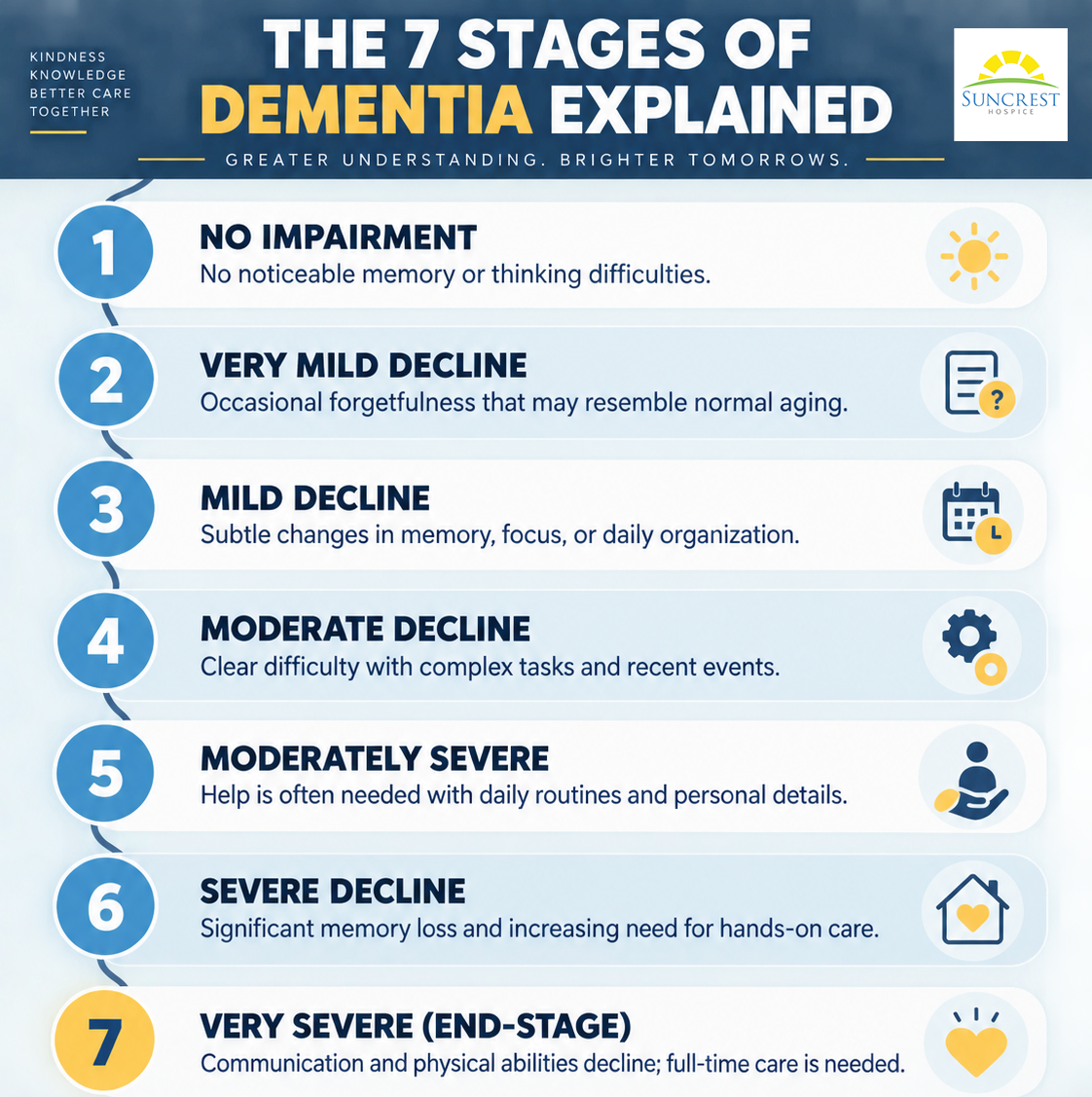
Short answer: Dementia progresses through 7 stages, from no symptoms (Stage 1) to end-stage dementia (Stage 7), using a framework called the Global Deterioration Scale. Stage 7 is when someone needs full-time care and can qualify for hospice. Each stage brings new memory, physical, and communication changes, and the pace varies a lot from person to person.
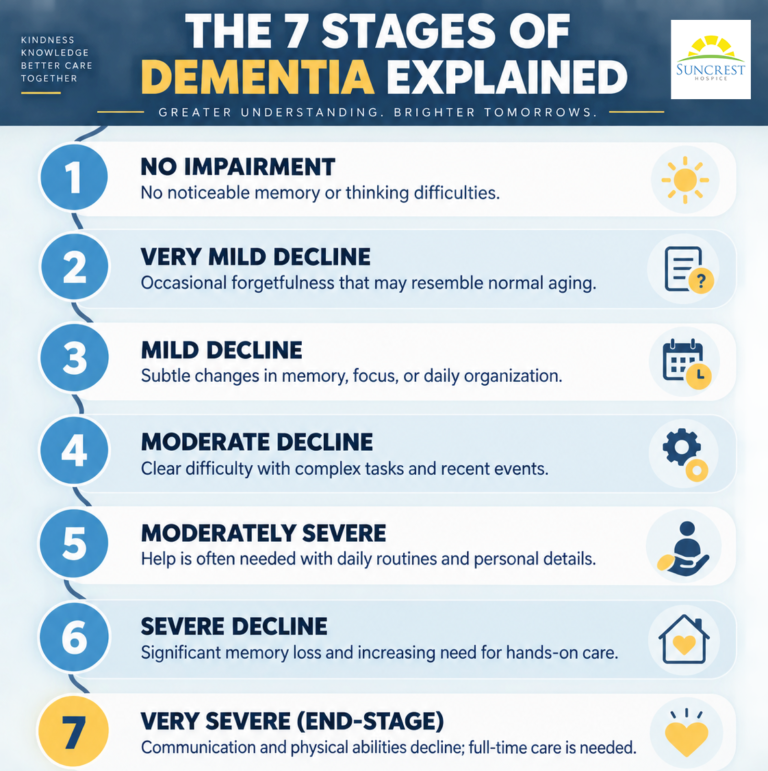
- The 7 stages of dementia: no impairment, very mild decline, mild decline, moderate decline, moderately severe decline, severe decline, and very severe (end-stage) decline.
- Stage 7 is end-stage dementia. This is when hospice care becomes an option under Medicare.
- The middle and late stages last the longest, often several years each, while the earliest stages can pass unnoticed.
- The same 7 stages line up with the FAST scale, the tool hospice teams use to confirm eligibility.
What Are the 7 Stages of Dementia?
The 7 stages of dementia come from the Global Deterioration Scale (GDS), developed by Dr. Barry Reisberg. It’s the most widely used framework for tracking how dementia progresses, from a person with no symptoms at all to someone who needs full-time, hands-on care.
Doctors and hospice teams often pair the GDS with a related tool called the FAST scale (Functional Assessment Staging Test), which breaks stages 6 and 7 into smaller steps. If you want the deeper breakdown hospice teams use for eligibility, we cover that in our FAST Scale for Dementia guide, which includes a free download.
No two people move through these stages at the same speed. Some stay in the middle stages for years. Others decline faster, especially with vascular dementia, which can progress in sudden steps rather than a steady slide. What’s true for almost everyone: the stages build on each other, and each one brings a real, noticeable shift in what a person can do on their own.
Stage 1: No Cognitive Decline
Stage 1 has no outward signs of dementia at all. A person functions completely normally, with no memory loss, confusion, or difficulty with daily tasks.
- No detectable memory problems
- Full independence in work, driving, and social life
- Not identifiable through a clinical interview or exam
This stage matters mostly in hindsight. Nobody is diagnosed at Stage 1. It’s simply the baseline before any changes begin.
Stage 2: Very Mild Decline
Stage 2 brings small memory lapses that most people write off as normal aging. Someone might forget where they put their keys or blank on a familiar word.
- Occasional forgetfulness about names or locations of everyday objects
- No changes noticed by family, friends, or coworkers
- Not detectable in a medical exam
At this point, there’s usually nothing to distinguish these lapses from ordinary forgetfulness. That’s part of what makes early dementia so hard to catch.
Stage 3: Mild Decline
Stage 3 is often the first point where family and friends notice something is different. Subtle changes in memory, focus, and organization start to affect daily life.
- Getting lost in familiar places
- Trouble finding the right word or remembering names of new people
- Losing or misplacing valuable items
- Difficulty concentrating and reduced performance at work
- Noticeable trouble planning or organizing
Stage 3 can last anywhere from 2 to 7 years. This is often when people first bring up their concerns to a doctor, and when a formal diagnosis becomes more likely.
Stage 4: Moderate Decline
Stage 4 marks the start of what’s usually called moderate or mild-stage dementia. Cognitive problems are now clear-cut and hard to miss.
- Difficulty managing finances or paying bills
- Trouble recalling recent events or conversations
- Getting confused about the current date or location
- Difficulty with complex tasks, like planning a meal or trip
At this stage, someone can usually still handle basic personal care, like dressing and bathing, on their own. Stage 4 lasts about 2 years on average.
Stage 5: Moderately Severe Decline
Stage 5 is when a person starts needing real help with daily activities. They can no longer manage independently, though they still retain a good sense of who they are and who their loved ones are.
- Trouble recalling personal details, like their phone number or address
- Confusion about the day, season, or where they are
- Needing help choosing appropriate clothing for the weather or occasion
- Still able to eat and use the bathroom without assistance
Stage 5 lasts about 1.5 years on average. This is often when families start looking seriously at additional support, whether that’s in-home help or a move to memory care.
Stage 6: Severe Decline
Stage 6 brings a sharp jump in care needs. Personality changes become more pronounced, and a person requires extensive, hands-on help with nearly everything.
- Requiring help getting dressed, bathing, and using the toilet
- Episodes of incontinence
- Difficulty recognizing family members, though they may still respond to a familiar voice or touch
- Wandering, agitation, or repetitive behaviors
- Major personality shifts, including suspicion, anxiety, or withdrawal
Stage 6 lasts about 2.5 years on average, making it one of the longest and most demanding stages for caregivers. The FAST scale splits Stage 6 into smaller steps (6a through 6e) to track this decline more precisely, which is part of why hospice teams often reference it alongside the GDS.
Stage 7: Very Severe Decline (End-Stage Dementia)
Stage 7 is end-stage, or late-stage, dementia. A person loses the ability to speak in any meaningful way, move independently, and eventually control basic bodily functions.
- Loss of speech, often down to a handful of words or no words at all
- Inability to walk or sit up without full assistance
- Difficulty swallowing, which raises the risk of choking and aspiration pneumonia
- Complete dependence for eating, bathing, and toileting
- Loss of bowel and bladder control
Stage 7 typically lasts 1 to 3 years, though this varies based on overall health and the care someone receives. This is the stage where hospice eligibility for dementia usually comes into the picture. We go through the physical signs that death may be approaching in more detail in our guide to 10 signs death is near with dementia.
7 Stages of Dementia Chart
Here’s a quick-reference chart for all 7 stages of dementia, side by side.
| Stage | Name | Key Signs | Independence Level |
|---|---|---|---|
| 1 | No Impairment | No memory or thinking problems | Fully independent |
| 2 | Very Mild Decline | Occasional forgetfulness, resembles normal aging | Fully independent |
| 3 | Mild Decline | Noticeable memory gaps, trouble with focus and planning | Mostly independent |
| 4 | Moderate Decline | Trouble with finances, recent events, complex tasks | Needs some assistance |
| 5 | Moderately Severe | Forgets personal details, needs help with daily routines | Needs regular help |
| 6 | Severe Decline | Needs help dressing, bathing, and toileting; may not recognize family | Needs extensive care |
| 7 | Very Severe (End-Stage) | Loses speech and mobility, cannot eat or care for self | Needs full-time care |
How Long Do the 7 Stages of Dementia Last?
The 7 stages of dementia can span anywhere from 8 to 20 years in total, though the timeline is different for everyone. Here’s a general breakdown of how long each stage tends to last.
| Stage | Typical Duration |
|---|---|
| Stage 1: No Impairment | N/A |
| Stage 2: Very Mild Decline | N/A |
| Stage 3: Mild Decline | 2 to 7 years |
| Stage 4: Moderate Decline | 2 years on average |
| Stage 5: Moderately Severe | 1.5 years on average |
| Stage 6: Severe Decline | 2.5 years on average |
| Stage 7: Very Severe (End-Stage) | 1 to 3 years |
These numbers are general estimates, not a prediction for any one person. The type of dementia matters too. Vascular dementia often moves in sudden steps tied to strokes, rather than the steadier decline seen in Alzheimer’s disease. Infections, falls, and overall health can speed things up or slow them down.
When Does Stage 7 Qualify for Hospice Care?
Stage 7 on the GDS scale generally lines up with Stage 7 on the FAST scale, which is the specific benchmark Medicare uses for dementia hospice eligibility. Reaching Stage 7 doesn’t automatically mean someone qualifies, but it’s the point where a hospice evaluation makes sense.
Medicare generally looks for a combination of these signs:
- Unable to walk, dress, or bathe without full assistance
- Urinary and bowel incontinence
- Speech limited to about six words or fewer a day, or no meaningful speech
- A serious complication in the past year, such as aspiration pneumonia, a urinary tract infection, sepsis, or a stage 3 or 4 pressure ulcer
Our hospice criteria for dementia guide walks through this in more detail, and our Medicare hospice benefit overview covers what’s actually included once someone enrolls. You don’t need a doctor’s referral to ask for a hospice evaluation. Any family member can request one.
Behaviors That Don’t Fit Neatly Into One Stage
A few common dementia behaviors show up across more than one stage, which is why they can be confusing to place on the GDS.
What Stage of Dementia Is Sundowning?
Sundowning, increased confusion and agitation in the late afternoon and evening, most often shows up in the moderate to severe stages (Stage 4 through Stage 6). It can appear earlier or later depending on the person, and it tends to ease again once someone reaches the most advanced part of Stage 7.
What Stage of Dementia Is Anger or Aggression?
Anger, irritability, and aggression are most common in Stage 5 and Stage 6, when frustration over lost independence combines with growing confusion. These behaviors usually come from fear, pain, or an unmet need the person can’t put into words, not from the person’s true character.
Supporting a Loved One Through Every Stage
What a family needs to do changes a lot from one stage to the next.
- Stages 1 to 3: Focus on getting a full diagnosis, discussing legal and financial planning while your loved one can still take part, and connecting with a support group.
- Stages 4 to 5: Start building a caregiving routine, look into in-home help, and research memory care options before a crisis forces a rushed decision.
- Stage 6: Lean on respite care to avoid caregiver burnout, and start the hospice conversation with your loved one’s doctor if serious complications appear.
- Stage 7: Shift the focus fully to comfort. This is where hospice and palliative support make the biggest difference for both the patient and the family.
If your loved one is in the later stages, our guide on hospice care at home for dementia patients covers what day-to-day support actually looks like.
Frequently Asked Questions About the 7 Stages of Dementia
How long do the 7 stages of dementia last in total?
From Stage 3, when symptoms first become noticeable, to the end of Stage 7, dementia typically spans 8 to 20 years. Stage 6 and Stage 7 tend to be the longest individual stages, each lasting a few years on average.
What is stage 7 dementia like?
Stage 7, or end-stage dementia, means a person has lost the ability to speak meaningfully, walk, or sit up without full support. They need help with every part of daily care, including eating, bathing, and toileting.
What stage of dementia is sundowning?
Sundowning most commonly appears in Stage 4 through Stage 6, when confusion and agitation increase in the late afternoon and evening.
What stage of dementia is anger or aggression most common?
Anger and aggression tend to peak in Stage 5 and Stage 6, often driven by frustration, fear, or an unmet physical need the person can’t express.
How is the FAST scale different from the 7-stage GDS?
The FAST scale and the GDS both use 7 main stages and largely line up with each other. The FAST scale breaks stages 6 and 7 into smaller sub-steps, which gives hospice teams a more precise way to track decline and confirm Medicare hospice eligibility.
What is the life expectancy at stage 7 dementia?
Stage 7 typically lasts 1 to 3 years, though this depends heavily on a person’s overall health and whether serious complications like aspiration pneumonia or repeated infections occur.
When should hospice be considered for someone with dementia?
A hospice evaluation makes sense once someone reaches Stage 7: unable to walk, dress, or bathe independently, with incontinence, very limited speech, and at least one serious complication like pneumonia or a pressure ulcer within the past year.
Get Support at Any Stage of the Dementia Journey
Watching a loved one move through the stages of dementia is exhausting, even when you know what’s coming. You don’t have to figure out the later stages alone. Suncrest Hospice provides comfort-focused care for patients in Stage 7 dementia, along with support for the whole family.
Contact us 24/7 to talk through your loved one’s needs, or check whether Suncrest serves your area below.