
Hospice Social Workers in Fremont, CA
Every Suncrest hospice patient in Fremont is assigned a licensed social worker from the first day of care. Not as a check-box. As a real member of the care team who shows up, knows the family, and handles the parts of hospice that have nothing to do with medications or equipment.
That means emotional support for the person doing the caregiving. It means navigating Alameda County’s systems to find the help a family actually qualifies for. It means sitting in difficult family conversations, facilitating decisions, and staying present through everything that follows. Contact the Fremont Suncrest team to learn more.
Social worker assigned from the first day of hospice enrollment
Covered under the Medicare Hospice Benefit at no cost to families
Bereavement counseling continues after a patient passes
Hospice Social Work in Fremont, CA
A hospice social worker is the member of the care team focused on the human side of end-of-life care. Not the clinical side. The nurse handles that. The social worker deals with everything the nurse cannot: what the family is going through emotionally, what practical resources they need, what conversations are not happening that need to happen, and what happens to the family after the patient dies.
In Fremont, that role carries some specific weight. This city is one of the most culturally diverse in California. A social worker serving Fremont families may be working with a multigenerational South Asian household where end-of-life decisions are made collectively. Or an Afghan family in the Centerville District where cultural and religious expectations around death and dying are specific and need to be understood, not overridden. Or a Chinese family where open discussion of a terminal diagnosis may conflict with deeply held values about protecting the patient from distressing information.
The Suncrest social workers serving Fremont understand these dynamics. They do not apply a one-size approach to every family. The care plan for each patient reflects the values, communication styles, and needs of that specific household.
The Initial Social Work Assessment in Hospice
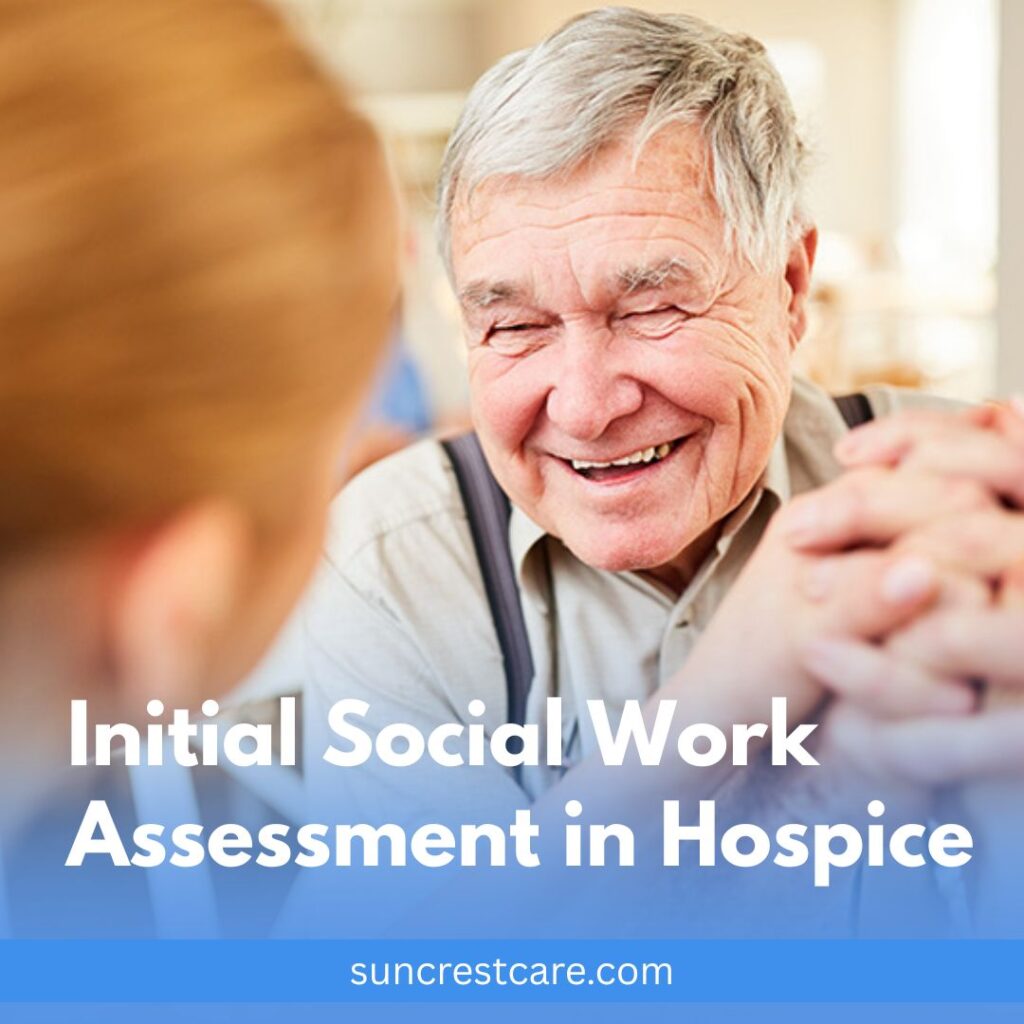 Within the first few days of hospice enrollment, the Suncrest social worker visits the home to conduct an initial psychosocial assessment. This is not paperwork. It is a conversation, often a long one, designed to understand the whole picture of what this family is facing.
What the Assessment Covers
The social worker’s initial visit typically covers:
- The patient’s emotional and psychological state: Are they at peace with the situation? Are there unresolved fears, unfinished business, or things they want to say or do before they die?
- Family dynamics: Who is the primary caregiver? Who else is involved in decisions? Are there tensions or disagreements that may affect care?
- Cultural and religious values: What does this family believe about death and dying? How do those beliefs affect what kind of support they want?
- Practical needs: Is the family having financial difficulty? Are there insurance questions? Do they need help accessing community resources in Fremont or Alameda County?
- Caregiver wellbeing: How is the primary caregiver holding up? What support do they need that they are not currently getting?
- Safety assessment: Is the home environment safe for the patient? Are there concerns about isolation, domestic dynamics, or caregiver capacity?
The findings from this assessment shape the care plan from the start. The social worker shares relevant information with the rest of the Suncrest care team so everyone (the nurse, the aide, the chaplain) is working from a shared understanding of this family’s situation.
Ongoing Visits Throughout the Hospice Period
After the initial assessment, the social worker visits on a regular basis throughout the hospice period, with frequency adjusted based on what the family needs. Some families have a social worker visit weekly. Others less often. The schedule changes as the patient’s condition changes and as the family’s needs shift. At the very end of a patient’s life, the social worker is often present to support the family through the final hours and the immediate aftermath.
 How Hospice Social Workers Support Fremont Families
 How Hospice Social Workers Support Fremont Families
The social worker’s role spans a wide range of needs. Here is what that looks like in practice for families in Fremont and the surrounding East Bay.
Emotional Counseling
Anticipatory grief, guilt, exhaustion, anger at the situation. These are real and they are hard to process alone. The social worker provides ongoing counseling for family members throughout the hospice period. This extends to all household members, including children and teenagers who are often the most overlooked in the process.
Alameda County Resource Navigation
The social worker knows Alameda County’s systems and connects families to the resources they qualify for but may not know about: In-Home Supportive Services (IHSS), the Area Agency on Aging, Eden I&R (the county 2-1-1 service), Tri-Cities Community Health, and local caregiver relief programs in the Fremont and Newark areas.
Advance Care Planning
If a patient has not completed an advance directive or POLST form, the social worker helps facilitate that conversation. In Fremont’s multicultural households, these conversations often require cultural sensitivity and time. The social worker is trained to navigate them without pressure.
Family Meeting Facilitation
When family members disagree about care decisions, or when there are difficult conversations that keep getting postponed, the social worker can facilitate a structured family meeting. Having a skilled, neutral professional in the room changes those conversations significantly.
Insurance and Benefits Coordination
Medicare, Medi-Cal, and private insurance each handle hospice differently. The social worker helps families understand their coverage, assists with paperwork, and addresses any billing questions or insurance concerns that come up during the hospice period.
Language Access and Cultural Competency
Fremont’s population includes large communities where English is not the primary language at home. The social worker coordinates language access and ensures that non-English-speaking family members are genuinely included in care conversations and decisions, not simply informed after the fact.
Social Work in Fremont’s Multicultural Community
Fremont is not a generic California city. It is the third most diverse city in the United States by some measures. The social work that happens here has to reflect that.
South Asian and Indo-American Families
Fremont has one of the largest South Asian populations in California. In many of these households, end-of-life decisions are made collectively across generations, elder care is a family obligation rather than a service to be outsourced, and death and dying may be shaped by Hindu, Muslim, Sikh, or Jain values with specific implications for care. The Suncrest social worker serving a family in the Mission San Jose neighborhood or Irvington District understands these dynamics and builds them into the care approach.
Afghan Families in the Centerville District
Fremont has the largest Afghan population in the United States, concentrated largely in the Centerville area. End-of-life care in these families often involves strong Islamic values around death and the dying process, specific family structure expectations, and the added weight of displacement and community trauma that many Afghan families carry. A social worker who understands that context provides fundamentally different support than one who does not.
Chinese and East Asian Families
In many Chinese families, openly discussing a terminal diagnosis with the patient, particularly in the presence of the patient, conflicts with deeply held cultural values around protecting family members from distressing news. The social worker navigates these situations with care, neither imposing a Western model of “radical transparency” nor simply deferring in ways that leave the patient uninformed. Finding the path that works for this specific family is part of the job.
Multigenerational Caregiving Households
Across many of Fremont’s communities, caregiving falls primarily on adult children who may be simultaneously working full-time in the tech industry, raising their own children, and managing the end-of-life care of a parent. The exhaustion and guilt that accompanies that situation is significant. The social worker’s role with these families includes real support for the caregiver, not just the patient.
Grief Support for Fremont Families
The social worker’s involvement does not end when the patient passes. Suncrest provides structured bereavement support to families in Fremont for 13 months following a death. This includes regular counseling contact, connection to grief support groups in the East Bay, and individualized support plans for family members based on their specific experience of the loss.
For Fremont families, the bereavement social worker understands that grief may be expressed and processed differently depending on cultural background. There is no single right way to grieve, and the support Suncrest provides reflects that.
For a broader look at hospice social work across the Bay Area region, see our hospice social work page for the Bay Area.
Questions About Hospice Social Workers in Fremont
There is overlap but they are not the same role. A hospice social worker is a licensed clinical professional (MSW or LCSW) who provides both practical assistance and emotional support throughout the hospice period, before and after death. A grief counselor is specifically focused on bereavement support after a loss. The Suncrest social worker in Fremont does both: they provide ongoing counseling throughout the hospice period and continue bereavement support for 13 months after the patient passes.
Yes. The social worker helps families understand and access benefits they qualify for, including Medi-Cal, Alameda County IHSS (In-Home Supportive Services), the Area Agency on Aging, and other county and community programs available in the Fremont area. Many families are not aware of what they qualify for. The social worker’s job includes finding out and helping the family access it.
Visit frequency is based on the family’s needs and adjusts throughout the hospice period. Some families have weekly social worker visits. Others meet less frequently. As a patient approaches the end of life, the social worker’s presence typically increases. The initial assessment visit is typically within the first few days of enrollment and is the most comprehensive. After that, the schedule is built around what the family actually needs.
Language access is the team’s responsibility, not the family’s. Suncrest coordinates interpretation services so that family members who are more comfortable in Punjabi, Hindi, Tagalog, Mandarin, Cantonese, Farsi, Pashto, or other languages can participate fully in care conversations. Non-English-speaking family members should never be left outside important decisions because of a language gap.
Yes. Family conflict around end-of-life care decisions is common and the social worker is specifically trained to work through it. Whether the disagreement is about care choices, family roles, communication styles, or unresolved history, the social worker can facilitate structured family meetings and help the family find a path that keeps the patient’s wishes at the center. They are not a mediator in a legal sense, but they are skilled at navigating these situations.
More Suncrest Services in Fremont
Hospice Care in Fremont
The full overview of Suncrest hospice services in Fremont, including the complete care team, eligibility, and how to get started.
Hospice Social Work in the Bay Area
A broader look at hospice social work across the Bay Area region, including how social workers support families throughout the region.
Spiritual Care in Fremont
Non-denominational chaplain services for patients and families of any faith background throughout the Fremont area and East Bay.
Bereavement Support in Fremont
Grief support for families for 13 months after a patient passes, including counseling and connection to East Bay grief resources.
Talk to the Fremont Suncrest Team
If your family is navigating a terminal illness in Fremont, you do not have to figure out the practical and emotional pieces alone. The Suncrest social worker assigned to your loved one is there from day one, not as a formality, but as a real, consistent presence through the whole process.
Call our Fremont team or reach out through the location page to start the conversation. Contact the Fremont Suncrest team here.